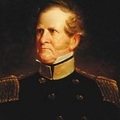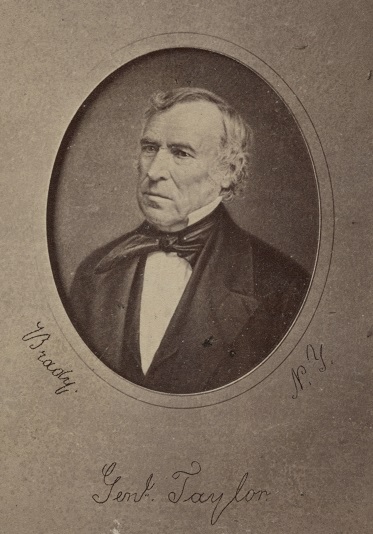
Portrait of President Zachary Taylor by Matthew Brady, ca. 1849.
Library of Congress
If you ask the internet “Who was the first American president to leave the United States while in office?” your answer will likely be some variation of, “Theodore Roosevelt when he visited the Panama Canal in 1906.” Short. Sweet. To the point—and dead wrong. Because the correct answer is Zachary Taylor, when he visited Canada at Niagara Falls in 1849.
Known as “Old Rough and Ready,” in 1848, following in the footsteps of Washington, Jackson and William Henry Harrison, Zachary Taylor was elected president based on little more than his reputation as a successful general. In Taylor’s case, this was due to his victories in the Mexican-American War.
Taking office in the midst of a national cholera epidemic that ultimately killed 150,000 Americans, the 64-year-old Taylor nevertheless decided it would be a good time to escape the oppressive heat of Washington by launching a political tour of the northern states, utilizing the era’s newest transportation system—the railroads.
Leaving Washington on August 9, 1849, Taylor began what was scheduled to be a leisurely trip across Pennsylvania by rail to Erie, traveling then by lake steamer to Buffalo, then again by train to Rochester and Albany, into New England, down to New York City and Philadelphia and home to the Executive Mansion in DC. It was a carefully planned trip that immediately went off the rails.
Reaching Harrisburg on August 13, Taylor was visibly ailing, showing all the symptoms of cholera. Undeterred, the old warrior forced himself to endure more days of innumerable handshakes and tiresome speeches and more nights of bloviating politicians and boring banquets. Still, he seemed to be recovering—until arriving at Erie where, experiencing a high fever and a severe case of the “shakes,” his doctor ordered him to bed for several days. But Taylor’s health appeared to improve and he opted to soldier on.
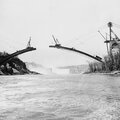
In Erie, Taylor was joined by his vice president, Buffalo’s favorite son, Millard Fillmore. Arm-in-arm, on September 1, they boarded a lake steamer bound for Niagara Falls. It was hoped and anticipated that Taylor would dock at Buffalo, which he had previously visited in 1840, dropping by to visit his daughter and son-in-law, Dr. Robert Wood, chief surgeon at the Buffalo Barracks. But alas it was not to be, likely because of the cholera raging in the city. So, the ship churned past Buffalo on its way to Black Rock and then on to the dock at Niagara Falls. Upon arriving, Taylor was so weak that he had to be helped to the carriage that took him to the Eagle House. But after a day of rest, once again Taylor’s health (or his stubbornness) rebounded. So much so that on September 3, following a visit to the falls, Taylor, his doctor, his son-in-law and the editor of the Washington Republic newspaper, decided on a sightseeing carriage ride. They traveled from Bellevue (today part of Niagara Falls, NY) to Canada, across the area’s newest tourist attraction, the newly opened suspension bridge over the Niagara River, built by Charles Ellet Jr. near the Whirlpool. It was the first span over the Niagara River.
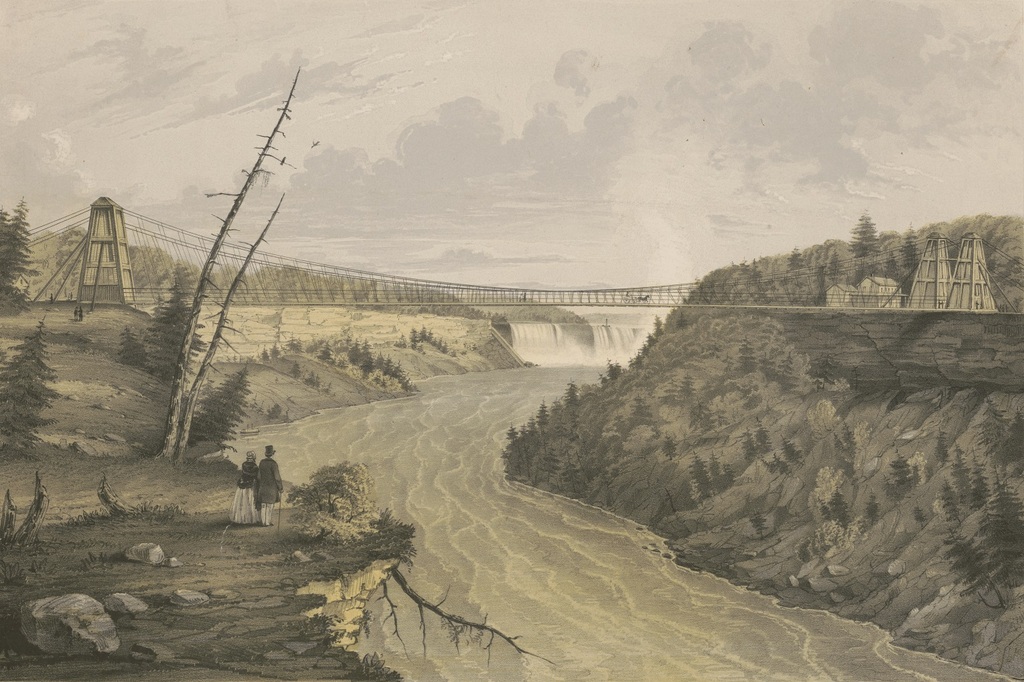
The bridge over which Zachary Taylor traveled to Canada was completed in 1848 by Charles Ellet Jr. It would be replaced several years later by a combined carriage-railroad bridge designed by John Roebling.
Library of Congress
Crossing the halfway point on the bridge, Taylor and his companions left the sovereignty of the United States of America and entered the realm of Victoria, arriving on the Canadian side in an area of woods and fields known as Stamford Township, today part of Niagara Falls, Ontario.
No bands—no flags—no cheering crowds greeted Taylor. In fact, no one in Canada (or in the U.S. for that matter) knew he was there. After a VERY short stay—which may have been no longer than the amount of time necessary to turn his carriage around and so short that Taylor didn’t even have the opportunity to stretch his legs on Her Britannic Majesty’s soil—the president returned across the bridge to the United States, indisputably earning the title, First American President to Leave the United States While in Office!
Why this event isn’t recognized today is puzzling. True, it wasn’t an official visit, but neither was Taylor’s drive into Canada a secret. By the late 1840s, the telegraph was already being used to transmit news to papers across the country for reprinting. As a result, the story of Taylor’s visit was being reported up and down the country, along with bulletins about his health. And certainly, it was no secret to readers of the aforementioned Washington Republic, which published the story, albeit in a low-key manner, stating that, “The President’s journey into Canada West yesterday extended no further than the end of the Suspension Bridge—a very brief visit indeed, to a 'foreign power.'”
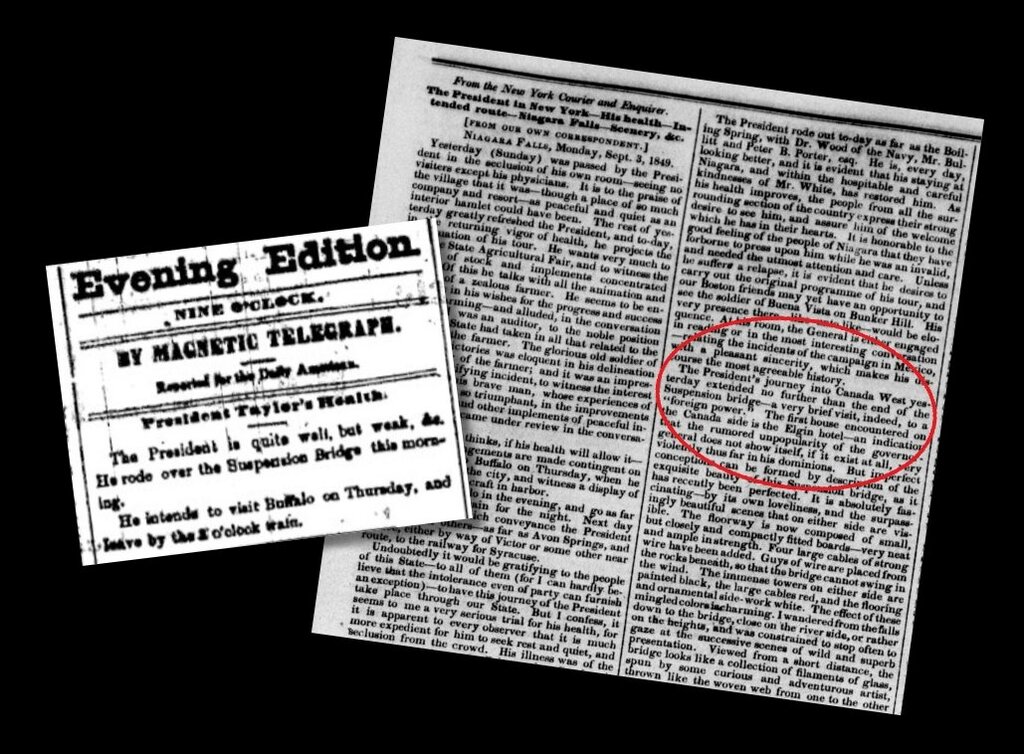
Taylor was accompanied on his brief trip to Canada by the editor of the Washington Republic, whose paper reported on the journey. Updates on the president’s health and travels were also reported in other papers.
(left) Rochester Daily American, September 4, 1849, and (right) The Republic, September 8, 1849.
Returning from his Canadian excursion, Taylor again suffered a relapse, one severe enough that his doctor insisted the rest of his trip be canceled. Not wanting to bump an ailing president across Western New York on a smokey train, Taylor was driven to Lewiston to board the new and luxurious lake steamer, Bay State, for a restful Lake Ontario cruise to Oswego. Whisked onto a train to Syracuse, where he sent his apologies for not being able to attend the state fair, he then traveled on by train, steamer and canal boat to Albany and points south to Washington.
Back in the Executive Mansion, Taylor appeared to recover fully from his ordeal. On July 4, 1850, at the site where construction of the Washington Monument had begun just two years before and then stalled, Taylor officiated under a blazing sun at a fundraiser to encourage private donations for the building fund. The next day, he was felled with severe abdominal pains and fevers. Whether from drinking pitchers of ice water and gobbling down iced cherries to ward off the heat of the day, from a resurgence of his cholera, or whether from poison (a conspiracy theory not put to rest until 1991), the true cause remains unclear. His condition rapidly worsened until he died on July 9, whereupon he was succeeded by Millard Fillmore.
Decades later, with Taylor a distant memory and his Canadian trip long-forgotten, Teddy Roosevelt—his toothy smile and pince-nez flashing, and with a hoard of reporters and photographers standing by—clambered onto a giant steam shovel at the Panama Canal, overshadowing Taylor and blithely walking off with the title of First American President to Leave the United States While in Office.
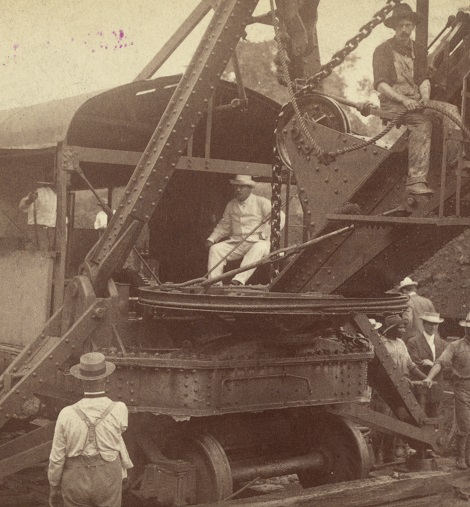
President Theodore Roosevelt in the cab of an American steam shovel at Culebra Cut, Panama Canal, 1906.
Library of Congress
Bully for him.
While we are at it, there’s also a tiny possibility that one of Taylor’s presidential predecessors crossed into foreign territory while in office, decades before Old Zach did. His name? James Monroe.
Soon after taking office, Monroe undertook a tour of the northern United States to get a look at the region’s political and social conditions and its military defenses following the end of the War of 1812. Sailing across Lake Ontario from Sackets Harbor to Fort Niagara aboard the United States Navy brig Jones, Monroe arrived at the fort on August 9, 1817. But his stay was short. Just about an hour. Then off he went, sailing up the Niagara River to a dock near the Falls. From there it was overland to Buffalo followed by a sail up Lake Erie to Detroit.
Here’s the kicker. Under the 1783 Treaty of Paris, which ended the Revolutionary War, the border between the United States and British North America was plunked down on an undefined line along the middle of the St. Lawrence River, Lake Ontario, the Niagara River and Lake Erie. Monroe had served in the Revolution and had been badly wounded fighting the British.
So—is it too much of stretch to imagine that, just to quietly tweak George III’s nose one last time, at some point along his voyage, Monroe’s ship “accidentally” (or perhaps actually by accident) happened to stray over the border into Canadian waters? It’s a fun idea to ponder.